Bread Shapes to Explore
If you divide a single bowl of fermented dough into a sphere, a ring, a slotted leaf, and a scissor-snipped wheat stalk, your tasters will swear they came from four different recipes. Changing dough geometry alters evaporation rate, oven spring vectors, and the ratio of caramelized crust to moist interior crumb.
Why Outer Skin Tension Controls Oven Spring
When dough enters a hot deck or Dutch oven, dissolved carbon dioxide comes out of solution and water vaporizes into steam, expanding the volume of gas pockets rapidly during the first ten minutes. Without a taut, elastic gluten cloak stretched across the exterior (known to bakers as the gluten mantle), the loaf spreads sideways like a pancake instead of springing upward.
Creative bread shaping uses controlled friction against an unfloured workbench, strategic folding seams, or braided intersections to direct where that expansion travels. By piercing a hole through the middle of a boule or cutting leaf vents into a flat sheet, you also remove the slowest-heating thermal core of the dough.
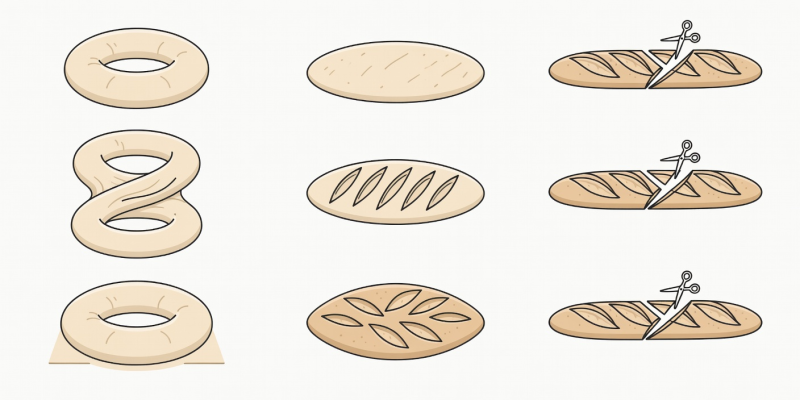
Step-by-Step Guide to Unconventional Loaf Forms
Try any of these five classic shapes on your next bake day. You do not need new ingredients—only a bench scraper, a pair of sharp kitchen shears, and a light touch with bench flour.
01. Épi de Blé (Scissor-Cut Wheat Stalk Baguette)
Shape a standard 350g baguette cylinder and proof it seam-side down. Just before loading into the oven, hold clean kitchen shears at a 45-degree angle to the loaf, snip three-quarters of the way through the dough, and gently fold the cut lobe to the left. Repeat 5cm further down and fold the next lobe to the right. Each point bakes into a crisp, pull-apart roll with a tender hinge down the center spine.
02. Couronne Lyon & Couronne Bordelaise (Crown Loaves)
For a Lyon-style crown, shape a firm boule, press your elbow or a rolling pin through the exact center, and gently stretch the ring until the central aperture is at least 12cm wide (otherwise proofing will close the hole). For a Bordelaise pearl crown, arrange eight small 90g boules inside a cloth-lined ring banneton around a thin sheet of dough, then fold the central sheet back over the balls like flower petals.
03. Provençal Fougasse (Slotted Hearth Leaf)
Best suited to high-hydration (75–80%) olive oil or herb doughs. Gently stretch the proofed dough into a triangle on parchment paper without degassing it. Use a bench scraper to press one long vertical cut down the center and three diagonal cuts on each side, then pull the slits open at least 3cm wide so they do not fuse back together in the oven.
04. Pain Tabatière (Jura Snuffbox Folded Loaf)
Shape a round boule, then roll a thin 4mm tongue of dough off one edge—leaving three-quarters of the boule plump. Brush the underside of the thin flap with a drop of water or oil and fold it back over the dome like a hinged box lid. During baking, steam lifts the thin flap into a crisp, curled visor.
05. Six-Strand Braided Challah & Swiss Zopf
When rolling dough cylinders for braiding, press outward from the center so each strand tapers slightly toward both tips, and always degas each strand evenly with the heel of your palm. If strands contain uneven gas pockets or slack tension, the braid will tear wildly at one intersection while staying dense at the ends.
Matching Hydration and Bake Time to Surface Area
Whenever you increase the exterior surface area of a loaf, water evaporates faster in the oven. Use the table below to adjust dough hydration and baking duration when switching from a standard round boule to an intricate shape.
| Bread Shape (500g Dough Weight) | Ideal Hydration Range | Internal Crumb Target Temp | Oven Time Adjustment (vs. Boule) |
|---|---|---|---|
| Standard Round Boule (Control) | 68% – 75% | 96°C – 98°C | Baseline (35–40 mins at 230°C) |
| Couronne Ring Loaf | 66% – 72% (holds ring wall) | 96°C | Reduce by 7–10 mins (heat enters from center hole too) |
| Épi de Blé (Scissor Stalk) | 65% – 70% (clean shear cuts) | 97°C in individual lobes | Reduce by 12–15 mins; vent steam early at 10 mins |
| Slotted Fougasse Leaf | 75% – 82% + 4% olive oil | 95°C | Bake 14–18 mins total on hot baking steel |
| Six-Strand Enriched Braid | 56% – 62% (including egg/fat) | 90°C – 92°C (avoid drying out) | Lower oven to 185°C; bake 28–34 mins |