Moulds Beyond the Ordinary
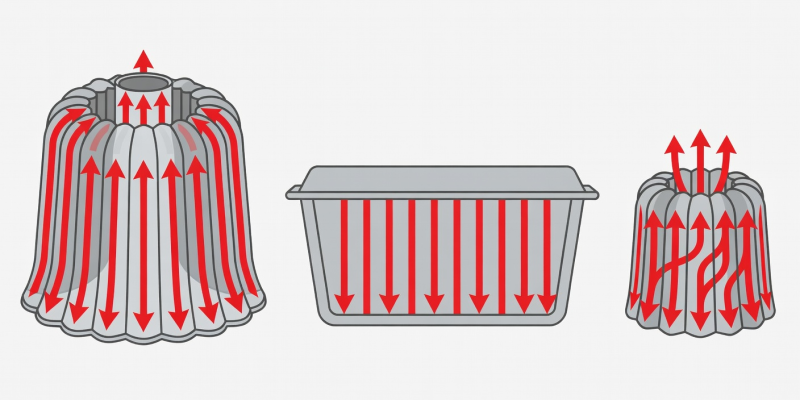
A baking mould is not merely a decorative container—it is a heat exchanger. Change the wall thickness from 1mm anodized aluminum to 6mm glazed Soufflenheim terracotta, or add a central chimney tube, and you completely rewrite how heat penetrates batter and how steam escapes.
How Mould Material Dictates Crust vs. Crumb
Before testing an unfamiliar mould with expensive vanilla beans or almond paste, examine what it is made of. In home ovens, heat transfers to your bake via three pathways: radiation from the oven walls, convection from moving air, and conduction directly through the metal, ceramic, or silicone touching the batter.
High-conductivity metals like tinned copper (roughly 380 W/m·K) and cast aluminum (160–200 W/m·K) deliver an immediate thermal jolt to the outer millimeter of batter. That rapid heat transfer triggers Maillard browning and caramelization while the center is still fluid, creating a crisp architectural shell. Low-conductivity materials like earthenware clay (1.1 W/m·K) and platinum silicone (0.2 W/m·K) act as thermal brakes, warming slowly so yeast doughs or delicate genoise sponges rise evenly without forming a thick, tough skin prematurely.
Testing Six Unconventional Baking Vessels
Each of these historic and specialized moulds evolved to solve a specific baking puzzle—whether cooking dense fruit-studded doughs all the way to the center or compressing sandwich bread into uniform square slices.
01. Alsatian Glazed Terracotta Kugelhopf (Kouglof)
Hand-thrown in potteries around Soufflenheim, France, these deep, swirling clay moulds feature a wide central tube. Because terracotta heats gently, enriched brioche dough has time to expand fully up the fluted walls before the crust sets. Always soak unglazed outer bases cautiously or cure new moulds with warm milk and butter before first use, and never shock hot clay on a wet countertop.
02. Bordeaux Tinned Copper Canelé Moulds
Designed for a thin, rum-scented batter rich in egg yolks and sugar. The secret is the dual-phase bake: 12 minutes at 230°C to blister the beeswax-and-butter lining against hot copper, followed by 45 minutes at 185°C to set the custardy interior without burning the fluted crown.
03. Corrugated Pullman Loaf Pan (Pain de Mie)
Named after railway sleeping cars for its long rectangular profile, a Pullman pan features a sliding metal lid. Once the dough rises to 85% of the pan height, closing the lid restricts vertical oven spring, forcing gas bubbles to subdivide into a fine, velvety crumb ideal for crustless tea sandwiches or thick French toast.
04. Heavy Cast-Aluminum Architectural Bundt Pans
Pioneered in Minneapolis in 1950 by H. David Dalquist, heavy cast-aluminum pans with sharp geometric facets require batters with strong emulsion stability. Avoid recipes with swirling jam ribbons or loose chocolate chips that sink into sharp tips and weld the cake to the metal.
05. Non-Tinned Carbon Steel Madeleine Plaques
Authentic scalloped shell plaques made of dark carbon steel absorb radiant oven heat far faster than shiny stainless pans. Chill your batter to 4°C overnight and bake in a 215°C oven so the outer shell sets rapidly, forcing expanding steam upward into the signature central hump (la bosse).
06. Hand-Carved Pearwood Springerle & Speculaas Moulds
Rather than going into the oven, these intaglio relief blocks emboss intricate botanical or folklore scenes onto stiff dough before baking. For Springerle, let the stamped hartshorn-leavened cookies dry uncovered for 12 hours at room temperature so the top crust hardens before baking, preserving every fine line while the base rises on "feet."
Why Cakes Stick—and the Laboratory Release Paste
When a cake tears apart during unmoulding, the culprit is rarely the pan shape alone. Standard butter is an emulsion of roughly 80–82% milkfat, 16–18% water, and 1–2% milk proteins (whey and casein). When brushed into sharp crevices and heated, the water evaporates and the milk proteins bond tightly with dissolved sucrose in your batter, acting like culinary spot-welds.
Even worse, dusting a buttered pan with high-protein bread or all-purpose flour creates a thin layer of hydrated gluten paste right at the metal boundary. For complex moulds, mix a batch of anhydrous release paste ("pan goop") using equal parts by weight of vegetable shortening, neutral liquid oil, and sifted rice flour or cocoa powder. Because it contains zero water and zero gluten-forming proteins, it creates a microscopic hydrophobic slip layer that releases every flute cleanly after a 10-to-12-minute cooling rest.
| Mould Type | Ideal Coating Agent | Cooling Window Before Inversion | Why Timing Matters |
|---|---|---|---|
| Cast-Aluminum Geometric Bundt | Anhydrous shortening + rice flour paste brushed with pastry bristles | 10 to 12 minutes sharp | Too early: warm starch hasn't set and cake shears; too late: sugar cools and glues to metal |
| Copper Canelé Cylinder | 60% food-grade beeswax + 40% clarified butter melted to 85°C | Invert immediately (0–1 min) | Beeswax solidifies below 62°C, locking the pastry inside if left to cool in the tin |
| Glazed Terracotta Kugelhopf | Softened cultured butter + whole blanched almonds pressed into flutes | 15 minutes | Thick clay retains heat longer; brief steam condensation helps loosen yeast crumb |
| Perforated Stainless Tart Ring | Light wipe of clarified butter on inside ring wall only | Remove ring 5 mins after bake | Pastry shrinks ~2% as moisture evaporates; sliding ring off early prevents condensation |